7 Tree Safety Checks to Make Before Hanging Holiday Lights
For estimated planning context, tree trimming can range from a few hundred dollars for smaller jobs to more than $1,000 for extensive work. This broad average range can vary significantly based on tree size, location, access, complexity, proximity to structures or power lines, and whether specialized climbing or equipment is required.
At Mike's Tree Service, we price the actual project after looking at the tree, the work being requested, the surrounding property, and the safest way to complete it. Two trees of similar height can require very different amounts of labor when one is in an open yard and the other is over a roof, pool, vineyard, driveway, or utility area.
| Scope | Estimated 2026 market context | How to interpret it |
|---|---|---|
| Targeted brush clearing | Site-specific estimate recommended | Area, vegetation density, access, and debris handling determine the scope |
| Professional land clearing | $1,396 to $6,170 per acre | Broad national planning range reported in Angi's 2026 land-clearing cost guide, not Mike's Tree Service pricing |
| Mike's Tree Service property estimate | Free estimate | Final pricing depends on the inspected scope |
Holiday lights on outdoor trees should begin with a look at the tree, not the box of decorations. A mature landscape tree may have a damaged branch, an old trunk injury, or a utility conflict that is easy to overlook while planning a display. Finding those concerns before installation gives you time to choose another location or arrange appropriate tree care. It also helps keep a temporary decoration from becoming a lasting problem.
At Mike's Tree Service, we help Napa homeowners with trimming, pruning, and hazardous tree concerns. These seven checks focus on living landscape trees and observations you can make from a safe ground position.
They help you recognize reasons to pause, rather than certify that a tree is safe. If a display requires climbing, working near electrical lines, or handling questionable limbs, change the plan and get the right help first.
Look for Dead, Cracked, or Hanging Branches
Start by viewing the intended decorating tree from outside the area where a branch could fall. Look for a partially detached limb, a visible split, or broken wood caught in another branch. UC IPM's guidance on recognizing hazardous trees identifies dead and dying limbs among the conditions that deserve attention. Do not stand directly underneath suspicious wood to get a better photograph.
Leaf loss alone does not establish that a branch is dead, particularly on deciduous trees during the seasonal transition. Tell us whether the limb broke recently, has changed position, or sits above a regularly used entrance. Our tree trimming services include evaluating and removing hazardous limbs when that work is appropriate. Keep people away from beneath a hanging branch while arranging an assessment, even if you decide to decorate another tree.

Check the Trunk, Bark, and Main Branch Connections
Look beyond the branch where you intend to hang the first string. An obvious trunk split, damaged connection between major stems, or old attachment buried in bark can change the decision for the whole tree. UC Agriculture and Natural Resources distinguishes superficial bark cracks from cracks extending into the wood in its landscape-tree inspection guidance. A photograph or holiday checklist cannot tell you the remaining strength of that connection.
Our article on whether a cracked tree can be saved before winter storms explains why the location and extent of damage matter. A new opening at a main union deserves a different response from a familiar pattern in outer bark. Do not probe a crack, scrape away bark, or attach a strap to pull separated sections together.
Pause decorating when the condition is uncertain, and describe what you can see from a safe location.
| Ground-level observation | What it tells you | Sensible next step |
|---|---|---|
| A partly detached limb remains overhead | There is damaged wood above the area | Keep the area clear and request help |
| A new split appears at a main connection | Structural separation may be present | Arrange prompt professional evaluation |
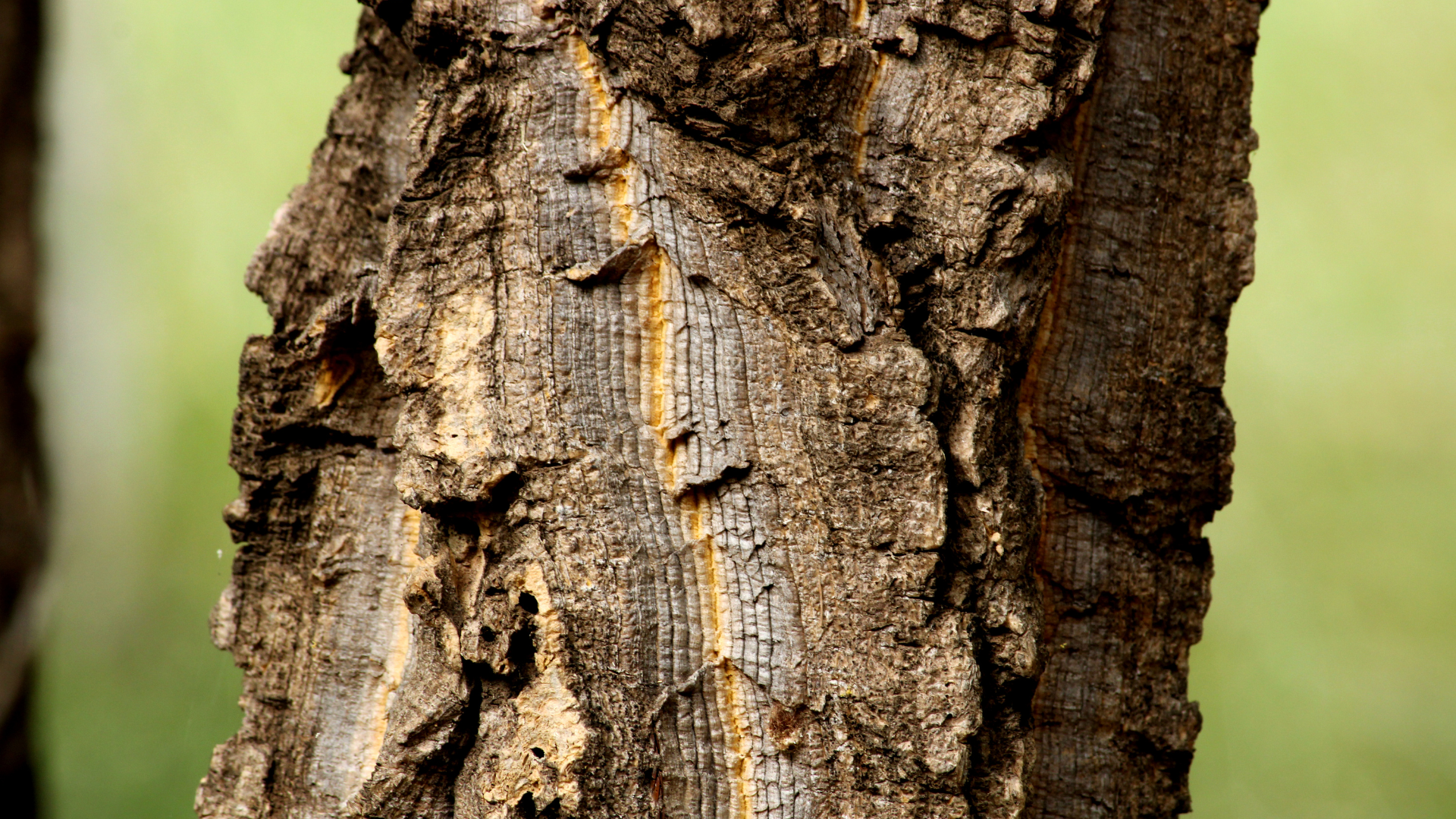
| Bark has a familiar rough texture | Appearance alone does not establish damage | Avoid making a diagnosis from texture alone |
| An old wire disappears into bark | An attachment may be embedded | Do not dig it out or decorate over it |
| The trunk has shifted or soil is newly lifting | The concern may extend beyond one branch | Stop work around the tree and seek assessment |
Record when you first noticed the change and whether it followed a storm, construction, or earlier tree work. That history helps explain the concern without asking you to investigate hidden damage yourself. A quiet day or a previously successful display does not establish the current condition of the tree.
Consider Whether the Intended Branches Suit a Light Display
Small twigs and delicate outer growth are poor places to concentrate a display. The City of Seattle's tree-lighting guidance recommends selecting trees able to carry string lights without visible bending and warns against tying smaller branches together to carry more weight. There is no reliable decorating rule that turns branch thickness into a guaranteed load rating. A branch that looks sturdy is not automatically suitable for a heavy ornament.
Keep the display within the tree's existing form
- Choose a modest design: Highlight accessible portions instead of trying to illuminate the entire crown.
- Put substantial props on their own supports: Avoid hanging heavy signs, figures, or bundled decorations from limbs.
- Leave questionable branches alone: A damaged attachment needs evaluation rather than a lighter version of the same display.
- Do not test strength with your weight: Pulling on a limb or hanging from it does not establish safe capacity.
For Christmas lights on mature trees in Yountville or St. Helena, start with the portions you can observe and access appropriately. A large canopy does not create an obligation to decorate every branch. If a proposed layout depends on a high or uncertain support point, use a ground-supported decoration instead. Changing the display can solve the decorating problem without cutting anything from the tree.
Identify Overhead Lines and Access Limits Before Installation
Look above and behind the canopy before raising a pole, ladder, or string of lights. Branches can hide conductors, and a tool may extend beyond the place you are watching. PG&E's yard-safety guidance explains that tree work near power lines requires specially qualified personnel. If the display involves a utility-adjacent tree, select another location and contact the utility provider about the conflict.
Do not cut a branch to create electrical clearance or attempt to retrieve a decoration caught near a line. Likewise, a tree-care appointment does not automatically mean the proposed work can proceed around energized conductors.
Keep decorating work at a scale you can handle without climbing into the tree or relying on branches for support. If the only way to reach a spot is an improvised ladder position or a long reach beneath damaged wood, leave that spot undecorated.
Inspect the Proposed Attachments for Bark Damage and Binding
Before installing anything, lay out how the light strings will be supported and removed. Staples, nails, and screws should not pierce bark for a temporary decoration. Tight zip ties or wire twist ties can also turn an attachment into a rubbing or binding point. The Morton Arboretum recommends soft, loosely tied materials rather than rigid ties that can cut into bark as a plant moves.
Check the route as well as the fastener
Look for narrow branch forks, rough contact points, and places where removal would require pulling a whole string through the canopy. Avoid linking separate branches together with a tensioned cord. A tree-friendly layout leaves room for movement without asking a branch to act as an anchor for another structure. If a string cannot stay in place without tightening or piercing the tree, simplify the design.
For holiday tree care in Napa, CA, the useful question is whether the attachment protects the living surface throughout installation, use, and removal. A product described as convenient is not automatically appropriate for bark. Stop if you discover an old tie cutting into the tree, and ask for advice before attempting to remove embedded material. Do not conceal the area beneath another wrap just to keep the lighting pattern continuous.

Check Light Ratings, Cord Condition, and Weather Exposure
Choose lightweight LED strings intended for outdoor use, and inspect them before installation. Broken sockets, exposed wires, and damaged plugs are reasons to replace the affected equipment rather than hide it among branches. The Electrical Safety Foundation's outdoor-decoration guidance recommends inspecting decorations and extension cords, protecting cord insulation, and using GFCI protection. Follow the manufacturer's limits for connections and power requirements instead of assuming all light sets are interchangeable.
Plan for rain and movement
- Use equipment rated for the setting: Outdoor lights need compatible outdoor cords and accessories.
- Keep walking routes clear: Guests should not have to step over cords or reach through branches to enter the house.
- Avoid tension between moving supports: A cord should not become a tight connection between separate trees or a tree and a structure.
- Pause work in poor conditions: Rain, wind, and slippery ground make an already difficult installation less manageable.
In Calistoga and American Canyon, the relevant check is your actual site exposure rather than a citywide assumption about wind. Look at how the intended route crosses open space and whether ordinary branch movement will pull on connections. After weather changes, review the display from a safe ground position without reaching for damaged equipment. If a fallen limb involves electrical lines, keep away and contact the utility provider rather than attempting cleanup.
Set a Removal Plan Before the Lights Go Up
Decide when the display will come down and how each section will be reached. Leaving wires around growing branches can eventually cause constriction, even when the lights remain unplugged. The Morton Arboretum advises removing holiday lights promptly and planning the layout for easy removal. Every temporary tie should have a planned removal date, including the ones hidden behind the trunk.
Take down one manageable section at a time rather than pulling a tangled string from the ground. If a cord catches, stop instead of yanking it through smaller growth or climbing after it. Keep a simple count or photograph of attachment locations so you can check that nothing remains. Once removal is complete, look for leftover loops and visible damage, and contact us if a tie is embedded or a branch appears injured.
Decide Whether to Decorate, Change the Plan, or Request Tree Care
The seven checks should lead to a practical choice about this year's display. An inaccessible branch may simply be left unlit, while a broken limb above the entrance needs attention regardless of decorating plans. Our role is to evaluate tree-care concerns and explain the appropriate work. We do not recommend topping or stripping healthy canopy to make a temporary lighting layout easier.
| Situation | Decorating decision | Tree-care response |
|---|---|---|
| No visible concern and a modest, accessible layout | Keep the design temporary and simple | Continue normal observation and maintenance |
| High branches are the only obstacle | Use a smaller or ground-supported display | Pruning is not automatically necessary |
| A damaged limb is above a visitor route | Keep the route clear and pause nearby installation | Request a hazardous-limb assessment |
| A major crack, new lean, or hanging limb is present | Stop work around the affected tree | Seek prompt professional evaluation |
| Electrical lines conflict with the plan | Choose another location | Contact the utility provider first |
When selective pruning makes sense
Tree trimming before Christmas lights should address an actual maintenance or hazard concern. Deadwood removal or work on a damaged branch may be appropriate, while cosmetic pruning can often wait for a suitable time. The species, condition, previous pruning, and amount of living tissue involved all influence the recommendation. The holiday date should not decide how much of the tree is cut.
Ask us to explain whether the concern is limited to a branch or involves the trunk, major unions, or roots. Our tree removal services address situations where removal is appropriate, but finding one damaged limb does not automatically justify removing the tree. If preservation is reasonable, the proposal should describe the selective work and any follow-up observations. This keeps the decision connected to the tree rather than the size of the decoration budget.
What should you budget for necessary work?
We provide
free estimates based on the actual tree and proposed work. Height, access, branch location, nearby buildings, equipment needs, and cleanup can affect the scope. For independent budgeting context, HomeGuide's tree-trimming guide reports a national average range of
$400 to $900 per tree. A limited deadwood job and complex work above a roof may fall outside the same planning range.
| Cost consideration | Budget information | What to clarify |
|---|---|---|
| Our project estimate | Free estimate | Which trees and tasks are included |
| General national trimming context | About $400 to $900 per tree | Broad market guidance rather than a property-specific price |
| Height and access | Depends on the work location | Whether climbing or specialized access is needed |
| Damaged limbs near structures | Depends on condition and handling requirements | How nearby property will be protected |
| Debris and cleanup | Depends on the agreed scope | Whether hauling is included |
Compare the work described, not just the total. A proposal should make the pruning objective and cleanup responsibilities understandable before you authorize service. Our guide to choosing a licensed tree service rather than an unlicensed contractor offers related questions to ask about credentials, insurance, and written scope. The most useful estimate explains what the tree needs and why.
Frequently Asked Questions
Do mature trees need trimming before Christmas lights?
Not automatically. A mature tree may need deadwood removal or attention to damaged limbs, but a display alone is not a pruning objective. Adjust the lights around suitable existing structure rather than cutting healthy branches for convenience.
Can I tell whether a branch is strong enough from its size?
Size alone cannot establish capacity. Condition, attachment, hidden defects, and the proposed load all matter. Avoid heavy decorations and do not pull on branches or climb them to test strength.
Are loose attachments safer than staples?
Avoid fasteners that pierce bark and attachments that bind tightly. Soft, temporary supports with room for movement are preferable to rigid wire or tightly cinched ties. Plan to remove the entire attachment after the display comes down.
What if I notice a crack while installing lights?
Stop work around the affected area and observe from outside the potential fall zone. A surface bark feature and a deep structural crack require different interpretations. Request evaluation rather than probing the crack or continuing to load the branch.
Can lights stay on the tree until next winter?
Seasonal strings and ties should come down after use. Forgotten attachments can tighten as branches grow or become difficult to remove. Keep the takedown plan manageable when deciding where to install lights.
Can Mike's Tree Service hang the lights after pruning?
Contact us for tree trimming, pruning, and hazardous tree concerns. Ordinary holiday-light installation is outside the service scope discussed here. If you hire a lighting installer, explain any tree concerns and resolve necessary tree work before installation begins.
Get Your Trees Ready Before Decorating Begins
If your lighting plans reveal a broken limb, visible crack, or neglected deadwood, we can help you understand the next step. Our tree trimming and pruning services support homeowners in Napa, Yountville, St. Helena, Calistoga, and American Canyon. We focus on appropriate tree care and preserving suitable living structure. A useful holiday preparation plan should benefit the tree long after the lights come down.
Contact Mike's Tree Service or call 707-226-2507 to request a free estimate for the tree work you are considering. Explain where the concern is and whether anything changed recently. Keep visitors and installers away from damaged limbs while arranging help. We will review the tree-care needs and explain the recommended scope before work begins.
Tree Trimming and Pruning Services
Related Blog: Can a Cracked Tree Be Saved Before Winter Storms?
Related Blog: Licensed Tree Service vs Unlicensed Tree Contractor